 Reclaim Protocol Docs
Reclaim Protocol Docs
Integrate Reclaim Protocol into your project in a few minutes.
Introduction
Reclaim Protocol lets you verify information about a user from any website. If a website has information behind a login that you want to verify, Reclaim Protocol can verify that.
Some examples
- Verify a user's salary at their current job using their employer's HR portal
- Verify a student's graduation details using their university's student portal
- ... as long as a user can login, we can verify the information behind that login
Flow of control
- User taps a button to initiate verification on your app/website
- User asked to login into the portal from which the required information can be verifed
- After successfully logging in, the user is asked to wait for a few seconds until verification is completed. This step can take between 2 to 30 seconds.
- The verification is sent back to your app/website's backend
Step 1 of 5
Choose the data source
The user selects the website or institution that contains the information to verify.
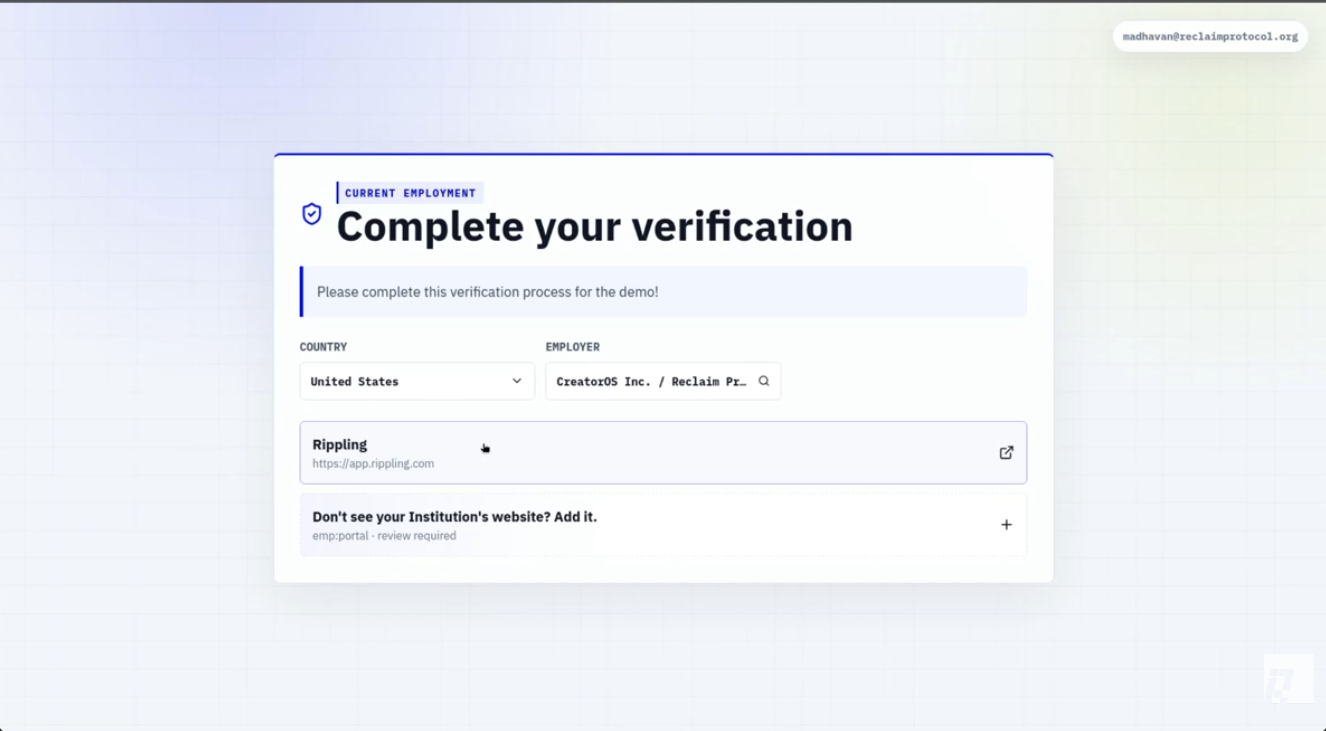
Choose how you want to verify
Verify information from a particular website
Use our AI Agent for the simplest integration
- Works with Claude Code/Codex/Cursor or any coding agent
Use the agent to build a provider for the website from which you want to verify
- Easiest to use, most flexible
Verify Education, Employment or Identity
Use our full stack solution, including UI. See the integration steps here.
Preconfigured for all major universities, employers and government portals, so that you don't have to configure each provider individually.
- Fewest lines of code to integrate
Manual integration
Don't trust an AI Agent? Use our open sourced SDKs to integrate verifications manually: NodeJS webapp, Flutter app, React Native app, Kotlin app, or Swift app.
Build your provider for the website you want to verify from manually using our devtool.
- Full control
Integrate verifiable API calls
Call an authenticated API, without user login, and generate an auditable proof of API call.
Best used when auth token is available, but shouldn't be revealed in the auditable artifact.
- No need to configure providers.
More resources
- Read the Reclaim Protocol Whitepaper, cited by multiple peer reviewed papers in reputable conferences
- Proxying is Enough, AFT 2025
- Zombie: Middleboxes that Don’t Snoop, USENIX 2024
- TLS2VC: A Decentralized WebProof Framework Enabling Web Data Credentialization, ACM, 2026
- SoK: What don’t we know? Understanding Security Vulnerabilities in SNARKs, arXiv 2024
- A Comprehensive Review of TLSNotary Protocol, arXiv 2024
- Do You Need a Zero Knowledge Proof?, ePrint 2024
- Securing Data Integrity in Modern Overlay Systems, Purdue dissertation 2026
- DracoBFT: Enabling Validators as Trustless Service Providers, preprint
- Entros Protocol: A Framework for Temporally-Consistent, Decentralized Proof-of-Personhood, Technical Whitepaper 2026
- RECreate: A Blockchain-Based Marketplace for Renewable Energy Credits with Intelligent Peer-to-Peer Trading Using Model-Based Multi-Agent Reinforcement Learning, IJRESM 2026
- Learn about how the protocol itself works in this video